Less Gear, More Tears: The Weird Psychology Behind Why Tiny Acoustic Shows Wreck You Emotionally

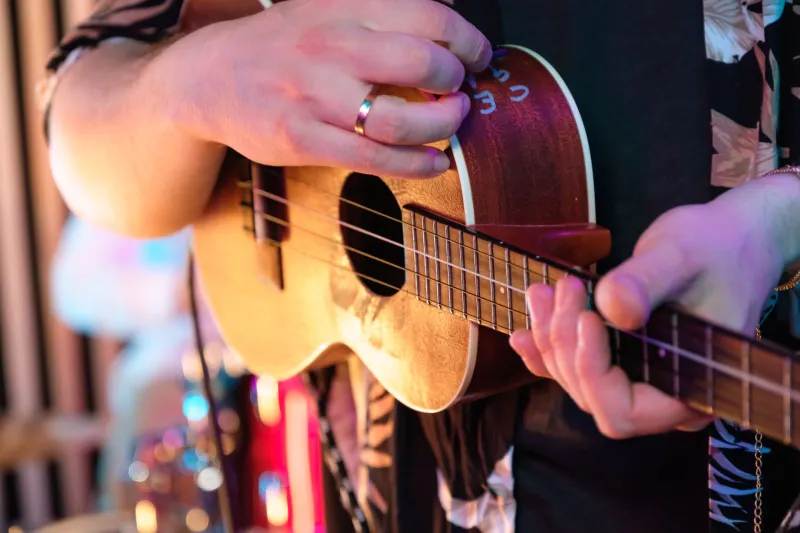
Photo by Photo by Jefferson Santos on Unsplash on Unsplash
Let's set the scene. You're at a sold-out arena show. The lights are blinding. There's confetti cannons, pyrotechnics, and a LED screen the size of a small country. The bass is so loud your molars are vibrating. By any objective measure, this should be the most emotionally overwhelming experience of your life.
And yet.
Somehow, you felt more when that one singer-songwriter played a 45-minute set in a poorly lit bookstore to an audience of 30 people, half of whom were just there for the free wine.
Welcome to what researchers, musicians, and the kind of people who air guitar in their kitchen at 11 p.m. are starting to call the Acoustic Intimacy Paradox — the deeply strange phenomenon where less production somehow equals more feeling.
The Pyrotechnics Are Lying to You
Here's the uncomfortable truth about big production concerts: all that spectacle is doing a lot of emotional heavy lifting that the music itself doesn't have to do. Dr. Nina Hartwell, a cognitive neuroscientist who studies auditory perception (and who, for the record, admits to a "respectable" air guitar habit), puts it bluntly.
"When you surround a song with massive production, you're essentially pre-loading the emotional response," she explains. "The lights tell you when to feel. The fog machine tells you this is epic. Your brain is being guided like a tourist with a very aggressive tour guide."
Strip all that away — put an artist on a stool with a single microphone and an acoustic guitar — and suddenly your brain has to do the work. And brains, it turns out, are way more invested in things they've had to figure out themselves.
This is part of why the air guitar community has long had a complicated relationship with over-produced concerts. There's a reason the most beloved air guitar moments — the ones people actually feel in their chest while miming a solo in their living room — tend to come from MTV Unplugged sessions, front-porch recordings, and lo-fi acoustic covers rather than polished stadium anthems. The rawness is the point.
Vulnerability Is Loud (Even When the Volume Is Low)
Ask almost any musician who has played both large venues and intimate acoustic sets, and they'll tell you the same thing: the small shows are scarier.
Take Nashville-based guitarist and songwriter Marco Delgado, who has performed everywhere from 15,000-seat amphitheaters to living room concerts with 20 paying guests. "At the big shows, the production is a shield," he says, laughing. "You mess up a note, nobody hears it over the PA and the crowd noise. You mess up at an acoustic show? Everyone in the room watches your face turn red. There's nowhere to hide."
And that vulnerability — that visible, audible humanness — is precisely what creates the emotional gut-punch.
Psychologists call this the "pratfall effect" applied to performance: we connect more deeply with people (and artists) when we see their imperfections. A slightly cracked note, a finger squeak on the fretstrings, a performer laughing at their own flubbed lyric — these aren't flaws. They're connective tissue between the artist and the audience.
At a stadium show, the artist is a deity on a distant stage. At an acoustic set, they're a human being sitting close enough that you can see them breathe.
The Sound Engineer's Dirty Secret
Pete Callahan has spent 22 years mixing live sound for everyone from club acts to festival headliners. He also moonlights as what he calls "a deeply committed air guitar enthusiast" — his words, delivered with zero embarrassment.
"People think more speakers equals better sound," he says. "But what you gain in volume and coverage, you lose in detail. An acoustic guitar in a small room has this three-dimensional quality — you hear the wood resonating, the pick hitting the strings, the breath before the vocal. In a big arena, all of that detail gets flattened out or lost entirely."
This isn't just audiophile snobbery. Research into psychoacoustics — the study of how humans perceive sound — suggests that the brain processes intimate acoustic sounds differently than amplified ones. Sounds that fall within the range of a human voice or an unamplified instrument trigger stronger activity in the areas of the brain associated with social bonding and emotional memory.
In other words, your brain hears an acoustic guitar in a small room and thinks: this is a person, talking to me, personally. It hears a stadium PA and thinks: this is a weather event.
Why Air Guitar Fans Already Knew This
Here's the thing about the air guitar community that outsiders tend to miss: it's never really been about the big flashy rock show. Sure, the competitions are theatrical and the solos are dramatic. But the most meaningful air guitar moments — the ones that happen in bedrooms, on road trips, in kitchens — are almost always tied to acoustic or stripped-down recordings.
There's a reason Eric Clapton's Unplugged album remains one of the best-selling live records in history. There's a reason Nirvana's MTV Unplugged performance is frequently cited as more emotionally resonant than their studio work. The absence of distortion, production sheen, and arena reverb forced listeners to actually meet the music.
Air guitarists understand this intuitively. When you're playing air guitar to an acoustic track, you're not performing spectacle — you're performing feeling. The invisible strings you're strumming aren't connected to an amp. They're connected to something internal.
The Small Room Effect
Social psychologists have a concept called "shared attention" — the idea that emotional experiences are amplified when they're shared with others who are visibly having the same experience. At a stadium show, you can't really see the faces of the 19,999 other people around you. At a 50-person acoustic set, you absolutely can.
"You look across the room and see someone else tearing up, and suddenly you're tearing up," says Marco Delgado. "That feedback loop doesn't exist at a big show. Everyone's just looking at the stage."
This is the Acoustic Intimacy Paradox in full effect: the smaller the room, the more emotional data you're receiving — from the artist, from the sound, from the people around you. Your brain is processing a richer, more human experience, even though the production budget is a fraction of the arena show.
So What Does This Mean for Your Next Concert?
Nobody's saying skip the big shows. Stadium concerts are their own kind of fun — the kind that involves foam fingers and overpriced beer and texting your friend "CAN YOU BELIEVE THIS" in all caps.
But if you want to feel something that sticks around past the parking lot, find the small acoustic show. The bookstore set. The house concert. The coffee shop open mic where a 23-year-old plays three songs and somehow dismantles your entire emotional infrastructure.
And when you get home, throw on an unplugged recording and play some air guitar in your kitchen. No production budget required. The strings you can't see are the ones that hit the hardest.