Why the Quieter the Show, the Louder the Feeling: The Science of Acoustic Closeness
Picture this: you're at a sold-out arena show. Pyrotechnics are going off. The bass is rattling your molars. Forty thousand people are screaming the same lyrics, and somewhere, roughly the size of an ant from where you're standing, is your favorite artist. You feel the energy. You feel the crowd. You feel your eardrums filing a formal complaint.
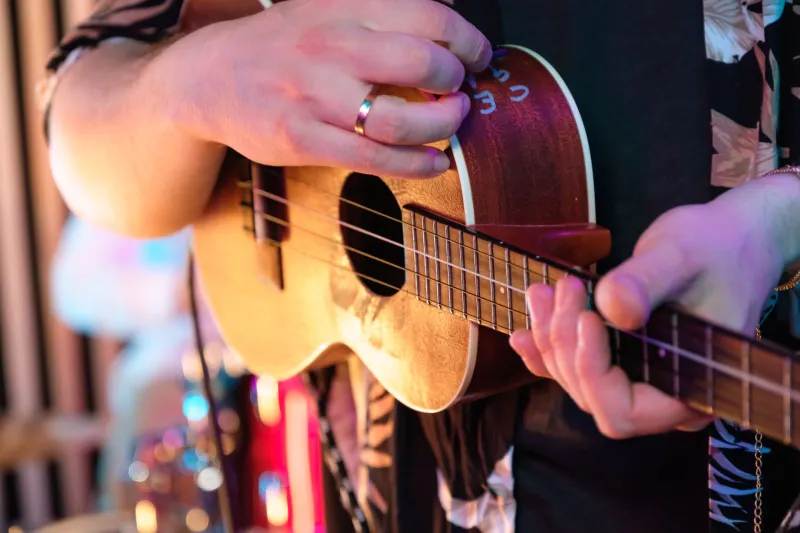
Now picture this: same artist, six months later, perched on a barstool at a 200-person venue, or maybe just on a couch with a phone propped against a coffee mug, playing an acoustic version of that same song. No production. No backup dancers. Just wood, wire, and whatever they had for breakfast showing on their face.
Which one made you cry?
If you answered the second one — congratulations, you are a normal human being with a functioning emotional nervous system, and also the subject of a growing body of research that's trying to figure out exactly why that happens.
The Vulnerability Variable
Music psychologists have a term they keep circling back to when discussing acoustic performance: perceived authenticity. It's a fancy way of saying that when the bells and whistles disappear, audiences start to believe they're seeing the real person. And belief, it turns out, is basically emotional superglue.
Dr. Arielle Donahue, a music cognition researcher who has spent the better part of a decade studying how audiences form emotional attachments to performers, puts it plainly: "Production creates distance. Not intentionally, but structurally. When you add layers — backing tracks, lighting rigs, choreography — you're also adding filters between the artist and the listener. Strip those away, and the brain interprets what it's seeing as unguarded. Vulnerability triggers empathy. Empathy triggers attachment."
In other words, the moment an artist plays a slightly imperfect chord on an acoustic guitar and doesn't stop to fix it, your brain goes oh, they're just a person — and suddenly you're emotionally invested in a way that a perfectly mixed stadium anthem never quite managed.
The Parasocial Shortcut
Parasocial relationships — those one-sided emotional bonds we form with public figures who have absolutely no idea we exist — are nothing new. But acoustic and unplugged performances have become surprisingly efficient at accelerating them.
Social media has a lot to do with it. A live-streamed acoustic set from an artist's living room, a lo-fi cover recorded on a phone at midnight, an impromptu performance shared to Instagram Stories — these formats mimic the visual and auditory cues of actual friendship. The low production quality reads as intimacy. The casual setting reads as trust. The slightly out-of-tune guitar reads as I didn't overthink this for you, I just played.
Marcus Tillman, a 28-year-old from Nashville who describes himself as a "devoted but not weird" fan of several independent acoustic artists, describes it well: "There's this one artist I follow who does these Sunday morning acoustic sessions on YouTube. No editing, no graphics, just her and her guitar. I've never met her. I will probably never meet her. But I feel like I know how she takes her coffee. That's insane, right? That's the power of an unplugged set."
It is, Marcus. It is a little insane. But science is on your side.
Small Rooms, Big Feelings
The physical environment of acoustic performances also plays a measurable role in emotional bonding. Researchers studying concert experiences have found that intimate venue sizes — think coffeehouses, listening rooms, and yes, the increasingly popular "living room concert" format — generate significantly higher reports of emotional connection than large-scale productions.
Part of this is simple physics. When you can actually see an artist's face without binoculars, your mirror neurons are getting a full workout. You notice the catch in someone's breath before a high note. You see them close their eyes during a bridge they clearly wrote about something painful. You watch their fingers on the strings. These micro-expressions and physical details are the building blocks of empathy, and they're basically invisible from the nosebleed section.
Emerging artists have caught on. Cleo Marsh, a singer-songwriter based out of Austin, Texas, who built her fanbase almost entirely through acoustic online sessions before ever playing a traditional venue, describes the strategy as intentional: "I figured out early that the people who watched my unplugged videos were the ones who showed up to everything else. They bought the merch, they shared the songs, they remembered lyrics I'd forgotten I'd written. The acoustic stuff wasn't just content — it was the relationship."
Air Guitar and the Empathy Loop
Here's where it gets interesting for those of us who have strong feelings about invisible instruments. The same psychological mechanisms that make acoustic performances so emotionally sticky are the ones that make air guitar such a weirdly powerful experience.
When you play air guitar — when you actually commit to it, close your eyes, feel the rhythm — you're not just goofing around. You're running an empathy simulation. You're inhabiting the performer's physical experience in the most literal, cord-free way possible. Research on motor mimicry suggests that physically imitating a musician, even with zero actual instrument involved, activates emotional processing centers in the brain associated with shared experience.
In other words, the air guitarist in the living room and the devoted acoustic fan in the front row are doing essentially the same thing: closing the distance between themselves and the music through physical and emotional participation. One of them just happens to look slightly more ridiculous doing it.
The Streaming Era Rewrite
The streaming era was supposed to make everything bigger, louder, and more produced. And it did, for a while. But something unexpected happened alongside the algorithmic maximalism: audiences got hungry for the opposite.
Unplugged content — acoustic covers, stripped-down sessions, raw live recordings — consistently outperforms its polished counterparts in engagement metrics across platforms. Comments sections under acoustic sets read like diary entries. Listeners describe feeling "seen" by songs they've heard a hundred times in their radio-ready versions but only felt when they heard them played alone on a guitar.
The data, the psychology, and frankly just a lot of anecdotal crying in headphones all point to the same conclusion: in an era of infinite production capability, the most powerful thing an artist can do is put the laptop down, pick up an acoustic guitar, and just play.
No fog machine required. Though honestly, a little mood lighting never hurt anybody.
The Takeaway (Unplugged, Obviously)
Acoustic performances aren't just a stripped-down version of the real thing. For a growing number of fans and researchers alike, they are the real thing — the format most likely to create the kind of emotional resonance that turns a casual listener into a lifelong devotee.
So the next time you find yourself three videos deep into an artist's acoustic YouTube session at 1 a.m., feeling inexplicably emotional about a song you first heard on a playlist, know this: you're not being weird. You're just experiencing the acoustic intimacy effect. Your brain is doing exactly what it was built to do.
And somewhere out there, an air guitarist is doing the same thing, just with slightly more hand movement.