Fake It Till You Shred It: How Pretending to Play Guitar Is Actually Teaching Gen Z to Play Guitar
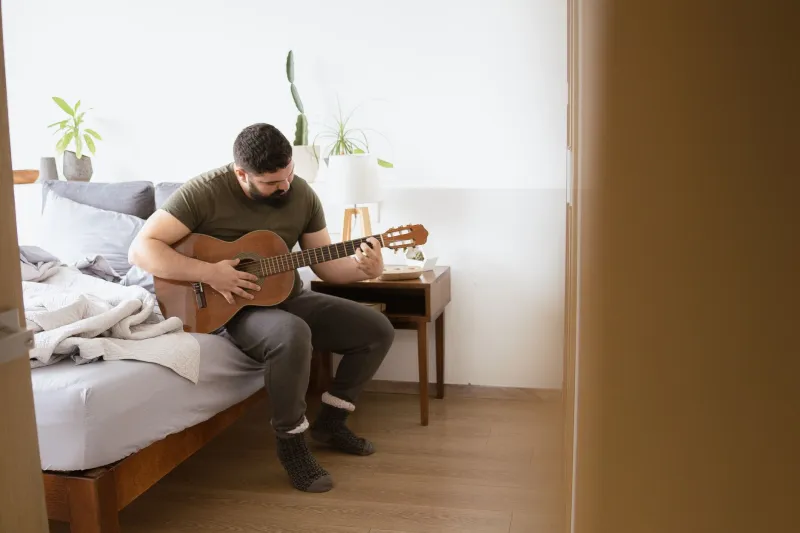
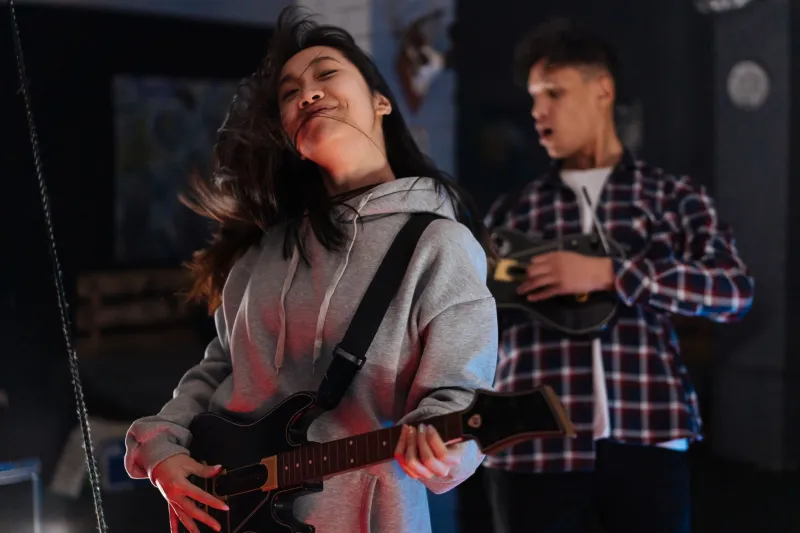
There is a teenager somewhere in America right now, standing in front of a mirror, absolutely destroying a silent version of "Eruption" by Van Halen. No guitar. No amp. No embarrassing wrong notes. Just pure, unfiltered rock fantasy playing out in a bedroom that smells like energy drinks and ambition.
Here's the twist: that kid might actually be learning something.
A quiet but genuinely fascinating pattern has been emerging among Gen Z musicians — a kind of creative pipeline that runs straight from air guitar to acoustic performance, bypassing the traditional gatekeepers of music education entirely. And the people who teach music for a living are increasingly paying attention.
The Stage Before the Stage
Ask almost any young musician how they got started, and buried somewhere between "my parents made me take piano lessons" and "I watched a YouTube tutorial at 2 a.m." you'll often find a chapter that sounds something like this: I used to just pretend. A lot.
That pretending, it turns out, is doing more work than anyone gave it credit for.
"What air guitar gives you before anything else is permission," says one independent music educator based in Austin who has been teaching acoustic guitar to teenagers for over a decade. "When a kid is air-guitaring, they're not afraid of being wrong. They're performing. They're feeling the music in their body. That's actually a really advanced starting point."
Advanced might sound like a stretch when we're talking about someone windmilling their arm at a bedroom wall. But consider what's actually happening during a committed air guitar session: the performer is internalizing rhythm, mimicking physical technique, syncing their movements to musical phrasing, and — perhaps most importantly — learning how to inhabit a song emotionally. That last part is something traditional music instruction often doesn't even get to until years in.
Muscle Memory for the Soul
The science here is genuinely interesting, and we've touched on some of it before in our coverage of air guitar neuroscience. But the specific connection to acoustic learning deserves its own spotlight.
When you watch someone shred an air guitar with real commitment, their fretting hand isn't just waving around randomly. Most dedicated air guitarists unconsciously mirror the hand shapes and positional shifts of actual technique. They're forming something close to muscle memory for movements they've never technically performed on a real instrument. When a real guitar finally lands in their hands, the physical vocabulary isn't entirely foreign.
"I've had students come in who've never touched a guitar, but they've spent years doing air guitar to their favorite songs," says another educator, this one running group music workshops in Nashville. "Their sense of timing is already there. Their feel for dynamics — when to go hard, when to pull back — that's already there. What we're doing is just attaching actual strings to instincts they already developed."
That's a pretty remarkable shortcut for an instrument that typically demands years of frustrating, blister-inducing groundwork before anything remotely musical comes out.
The Judgment-Free Ramp
One of the most consistent things you hear from young musicians who took the air-guitar-first path is how much the absence of judgment mattered. Learning a real instrument in front of other people — or even in front of yourself, honestly — is a vulnerable experience. You sound bad. You sound bad for a long time. That's just the deal.
Air guitar has no such problem. You can be a god in your own bedroom. You can front a stadium crowd of zero people and absolutely nail every solo. That experience of performing without consequence builds something that's surprisingly hard to manufacture in a formal lesson setting: genuine stage confidence.
Kayla, a 21-year-old singer-songwriter from Portland who now performs regularly at local acoustic showcases, describes her air guitar years as "basically theater school for musicians who didn't know they were musicians yet."
"I used to perform entire concerts alone in my room," she says, laughing. "Like, full sets. I knew every transition, every moment where the crowd was supposed to go crazy. When I eventually got on an actual stage with an actual acoustic guitar, I wasn't scared of the performance part. I'd already done it a thousand times. I just had to learn the notes."
That might be the cleanest summary of the pipeline: air guitar handles the performance, acoustic lessons handle the technique. Together, they produce something more complete than either could alone.
Skipping the Gatekeepers
There's also something worth naming about what this pathway avoids. Traditional music education — private lessons, school band programs, formal conservatory tracks — comes loaded with gatekeeping, cost barriers, and a particular kind of cultural seriousness that can feel alienating to kids who just want to rock out. Not everyone has access to a $60-an-hour guitar teacher. Not everyone thrives in environments where they're being formally evaluated on their progress.
Air guitar is radically democratic. All you need is a song and a willingness to look ridiculous. It meets young people where they are — in their rooms, on TikTok, at parties — and asks nothing of them except enthusiasm.
For a generation that has largely taught itself to do everything from cooking to coding through online videos and trial-and-error, the idea of developing musical intuition through performative play before ever picking up a real instrument fits perfectly into how they already learn. It's self-directed. It's low-stakes. It's genuinely fun.
"We keep trying to figure out how to make music education more accessible," one music teacher noted. "And meanwhile, kids are literally inventing their own on-ramp and we're not even acknowledging it."
From Invisible Strings to Real Ones
The air guitar community — competitive and casual alike — has always known that what they do isn't nothing. The physical commitment, the emotional expressiveness, the sheer musicality required to truly sell an invisible performance: none of that is accidental or empty.
But the emerging story of air guitar as a genuine creative training ground for acoustic musicians adds a new dimension to the conversation. It suggests that the line between "pretending to play" and "actually playing" is a lot blurrier than music traditionalists might like to admit.
Maybe the bedroom mirror shredder and the open-mic acoustic performer aren't as different as they look. Maybe they're just the same person at two different points in the same journey — one finding the music in their body, the other finding it in their fingers.
Either way, the strumming started long before the guitar showed up.